HTC Desire 620 in the works, Taiwan's NCC reveals


The NCC is Taiwan's equivalent of the USA's FCC, and its documents have revealed a new smartphone that is currently in the works: the HTC Desire 620.


Not one, but two versions of this yet unheard of upcoming handset have been certified by the NCC. The Desire 620h will top out at 3G (HSPA) networks, while the Desire 620u will support 4G LTE.


Both models will have dual-SIM functionality built-in, and that unfortunately is everything we know about the Desire 620 right now.


Given its name, however, we can speculate that it shall act as a successor to the Desire 610 (pictured above), which was unveiled in early 2014. It could also serve the same role for the Desire 616, but that has only arrived on the market in June, and it would be a bit early for a refresh.


It's unclear if we'll see the new Desire 620 across the world, or if its release will be limited to a few Asian markets, like many other Desire-branded devices before it. Hopefully we'll find out more about it soon.

Source (in Chinese) | Via


Tizen-running dual-SIM Samsung phone spotted at the FCC


Samsung's been theoretically launching Tizen smartphones left and right for years. Actually though, we've yet to see one shipping product running the mobile OS that was once seriously thought to be able to take on Android.


For the umpteenth time, we might be close to the release of the first Samsung Tizen device. This won't be high-end like the "indefinitely delayed" Samsung Z, rather a low-end offering that might be headed to India as soon as next month.


The SM-Z130H model number was first spotted in a few import listings for accessories on an Indian tracker back in July. And now it's been certified for sale by the FCC.


The Commission's documents don't shine much light on the phone's specs, except that it will have dual-SIM support, Wi-Fi, and Bluetooth. According to a different import listing from India, it will come with a 4-inch touchscreen.


As such a low-end device, the SM-Z130 will have to be very cheap in order to sell, given that the software platform it will come with hasn't been proven yet.


Source | Via


New Lollipop build for Samsung Galaxy S5 gets showcased


A few weeks ago we brought you images and video showing what an early build of Android L for the Samsung Galaxy S5 looked like.


Since that point, the Korean company's engineers have been hard at work tweaking things and integrating the TouchWiz UI with the new version of Android. And today it's the turn of a newer build of Android 5.0 for the Galaxy S5 to get showcased in all its glory.


Android 5.0 Lollipop on Samsung Galaxy S5


Samsung has refined many design bits, as you can see in the first two screenshots above. The device information page still doesn't say the word Lollipop, but the Android version is now listed as 5.0, instead of the "L" we saw last time.


The new leaked build has mostly UI enhancements compared to the old one. A fingerprint lock screen like the one in the Galaxy Note 4 is present, there's a new system font, new animations, a Google Search bar in the Recents menu, the brightness slider in the notification area has a new color, "Interruptions" has been removed from Sound settings, the Gallery has new filters, Contacts has a new search box, and stock apps with Material Design get the colored status bar.


The green elements in Google's Lollipop theme have been replaced with Samsung's blue, Settings has new icons, there's a new UI for setting the wallpaper, and better spacing between items in the power off dialog. The Music, Clock, and Calculator apps all come with improved designs now too.


Clearly Samsung Galaxy S5 owners across the world are eagerly awaiting this update, and it definitely looks like it's progressing nicely. Android 5.0 Lollipop might hit the Galaxy S5 before the end of this year, according to past mumblings.


Source


Samsung Ativ S gets updated to Windows Phone 8.1


The Samsung Ativ S is now ready to enter the Windows Phone 8.1 club. Lagging behind several Nokia handsets, the smartphone launched two years ago is finally starting to receive an over-the-air update to Windows Phone 8.1.


Owners of the Ativ S in both Italy and Germany have reported getting asked to perform the update. Furthermore, Samsung confirmed the rollout for unbranded units sold in Italy, so other European countries should see it pretty soon, we assume.


As is usually the case with such things, the rollout might take a while, so perhaps don't lose sight of your patience just yet.


The update comes with a few new features, such as the Action Center for notifications and shortcuts, the ability to use a background image for the tiled home screen, a swipe-enabled keyboard, an optional third row of tiles, improved Bing search, separate volume levels for ringtones and notifications and for media files and apps, a new layout for the Camera app, live folders, and a screen sharing option (that works only via USB).


Music and Videos are now two separate apps. The dialer, calendar, task manager, and Internet Explorer have been updated too, sporting better performance and graphics.


Source (in Italian) | Via 1 (in Italian)Via 2


Limited edition Gresso Regal encases Android 4.2 in titanium


Form over function becomes more appealing when there's exclusivity involved – only 999 units of the new Gresso Regal will be produced. The Android-powered smartphone follows Gresso's Luxury minimalism design tradition and is based on a Grade 5 solid titanium plate.


Gresso tries to hide its snark when it points out that key advantages of titanium are extra durability and resistance to bending. It takes 8 labor-intensive hours to mill the case on high-tech equipment.


Gresso Regal


"Directional polishing" is applied to the back panel, which takes 3 hours to create the desired metal texture, which the company claims makes the panel light but durable. The Gresso logo (also made of titanium) itself takes 2 hours to machine and then it goes to manual polishing. It's attached to the phone with special titanium screws.


The Gresso Regal measures 8.8mm thick, which allegedly makes it the "thinnest luxury phone on the market" (it's certainly not the thinnest overall, Oppo R5 is about half as thick).


That's it for the luxury, here are the geek specs: a 5" 1080p screen with Gorilla Glass, 1.5GHz quad-core processor (not clear what kind), Android 4.2, 13MP main camera and a 5MP selfie camera, plus 32GB of storage.


The Gresso Regal is already available for purchase through www.gresso.com and will set you back $3,000. The company provides free worldwide delivery. Each phone will be stamped with a number and the numbers only go up to 999. Not that the luxury smartphone market is huge.


OnePlus one leaks with yellow StyleSwap back, possibly Kevlar


We've seen the OnePlus One in Sandstone black, in white, in wood, bamboo and even in Denim but we haven't seen it in Kevlar, until now.


Two images have surfaced showing the OnePlus One with an interesting yellow back that could be the Kevlar back OnePlus teased a while back with its StyleSwap covers.


OnePlus One kevlar back (click to expand)


StyleSwap was the idea to allow users to change the back panels of the OnePlus One but has proven an issue for the company, which hasn't rolled it out just yet. It means to soon, though - a small portion of Bamboo back covers have been made and could soon become available to users.


The OnePlus One is set to go on another pre-order on November 17 so perhaps we'll see this limited edition model along with a Bamboo one then.


Source | Via


HTC ends Q3 on a $19 million profit, hopes for the best in Q4


Just like its unaudited report suggested earlier this month, HTC continues its winning streak in Q3. HTC's financial report for the Q3 2014 states the company made a profit of $19 million (NT$0.6 billion). Revenue for the period is $1.38 billion (NT$41.9 billion), which is down from $2.17 billion from the previous quarter.


The company is content with how the HTC One (M8) held its ground for the period and continued to sell well despite growing competition. The mid-range Desire line-up is also profitable for HTC, but it didn't specify exact shipment figures for any device.


In the last quarter, the HTC One (M8) was the main culprit for the company's $92 million profit turnout. HTC is looking up for a similar to Q3 last quarter of the year with a revenue of $1.38 billion – $1.55 billion.


Source (.pdf)


Sony posts a quarterly loss, sells 9.9 million smartphones


Sony had a positive quarter three months ago but it's back in the red. The company actually posted increased sales of $17.45 billion (up 7.2% on a yearly basis) in large part thanks to strong PlayStation sales and strong performance of Sony's image sensor business. The company did take a hit in sales after parting with its computer business, though.


The end result for the quarter is a consolidated operating loss of $785 million compared to an operating profit of $124 million in the same quarter last year. Still, the loss is about half of what some analysts expected. The "significant deterioration" is to a hefty impairment charge to the tune of $1.6 billion due to the newly formed Mobile Communications segment, which was split off from the computer business.


This unit recorded a slight increase in sales but took a massive operating loss. Sony shipped 9.9 million smartphones this quarter, a minor decrease compared to the 10 million a year ago. The company lowered its full-year prediction from 43 million to 41 million sales, still above the 39 million it sold in 2013.


The outgoing CFO said Sony will pull out of China (where locals like Xiaomi rule the market), while the incoming head of the mobile division will focus on improving relationships with carriers.


The gaming division took in $2.8 billion in sales (up 83.2% year-on-year) but the operating profit worked out to just $200 million (last year the division posted a loss in the same quarter). Sony sold 3.3 million PlayStation 4 consoles during the quarter, increasing its lead over rival Microsoft.


The division producing image sensors earned $2.3 billion in revenue and posted an operating profit of $271 million thanks to a higher demand of mobile phone cameras. Imaging products (Sony cameras) brought in an additional $1.6 billion in revenue and $184 million in operating income. The division is reporting a shift away from low-end cameras towards value-added models and a "significant" decrease in unit sales of digital cameras.


The TV segment recorded $2.6 billion in sales and $73 million in operating profit (also recovering from a loss). A dropping average selling price was counted with a shift to higher-end models.


Financial services remain Sony's most profitable business with $437 million in operating income. You can see how Sony Pictures and Music did in the press release linked below.


Source 1 (PDF) • Source 2 (PDF) | Via


Meizu MX4 Pro to be bigger than the non-Pro after all


The Meizu MX4 Pro leaks suggested a new chipset and higher res screen but almost everything else was supposed to remain the same. A new leak shows the back panels of both the regular MX4 and MX4 Pro and the Pro is clearly bigger.


It's hard to tell how much bigger exactly, but a benchmark had it listed as 5.5". Benchmarks are rarely very accurate when it comes to screen size but it sounds about right. The benchmark also showed the resolution of the bigger screen will be upgraded to the unusual 2,560 x 1,536 pixels resolution.


Meizu MX4 and MX4 Pro back panels


The chipset will be an Exynos 5430 Octa (instead of the MediaTek in the regular MX4), while the camera will still be based on Sony's 20.7MP sensor with 2160p video capture. It seems there will be a choice of FlymeOS or YunOS.


We're still waiting for the Meizu MX4 Pro to be officially announced, which the rumor mill says will happen sometime in the next month.


Source (in Chinese) | Via


Andy Rubin, co-founder of Android, leaves Google


Andy Rubin has left Google. Rubin was heading Google's robotic division but has now left the company to start his own incubator for hardware startups. He will be replaced by James Kuffner.


Andy Rubin is the co-founder and ex-CEO or Danger Inc. and Android Inc. He oversaw the development of Android until March 2013, when Sundar Pichai took over and Rubin went on to manage Google's robotics division.


Source


Xiaomi could be working on a low-end 9.2-inch tablet


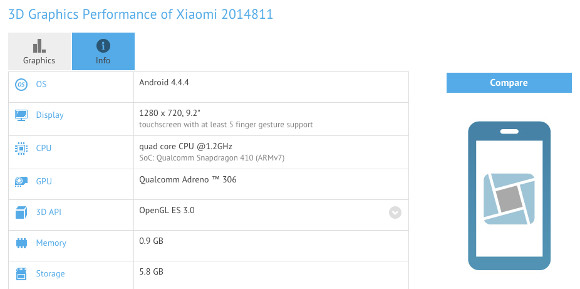
Now that it's become the world's No.3 smartphone manufacturer, Xiaomi may be looking to expand its tablet lineup, which so far consists only of the 7.9" MiPad.


The Chinese company's next tablet might be a decidedly low-end affair, however. A new benchmark result has surfaced, and with it a spec list for a yet unreleased Xiaomi device with a 9.2-inch touchscreen.


The new tablet will have a low-res panel, with 1,280x720 resolution. This isn't standard for Android tablets (which usually go for 1,280x800 and a slightly squarer aspect ratio), then again the MiPad didn't come with a standard resolution and aspect ratio for the Android world either.


Powering up the leaked tablet is a 64-bit Qualcomm Snapdragon 410 SoC with a 1.2 GHz quad-core CPU, an Adreno 306 GPU, and 1GB of RAM. Built-in internal storage space is 8GB, of which around 5.8GB will be user accessible.


The benchmark oddly doesn't feature any information about this device's cameras, but it does say it will sport a SIM card slot, so it will have mobile data connectivity integrated. It's also got Bluetooth, GPS, and Wi-Fi.


If this is a real product that's currently in development by Xiaomi, we'll surely find out more about it pretty soon through subsequent leaks.


Source | Via


Kantar: Android grows as iOS and Windows Phone decline in Q3


According to the latest Kantar WorldPanel report on mobile operating system market share, Android continues to take the lead marking a slight growth. Its main rivals, iOS and Windows Phone, declined slightly in their respective market share numbers.


In both Europe (EU5) and the US, Android leads its competitors with a market share of 73.9% and 61.8%, respectively. In Europe, Apple takes 15.4% of the market, while Microsoft with Windows Phone manages 9.2%. Interestingly, iOS marks a decline in the US of 3.3 percent points to 32.6% compared to Q2. Windows Phone's presence is also shrinking and is now 4.3% from 4.6%


As far as manufacturers go, LG and Motorola have been doing great in the US and Kantar sees them in a better position to fight with Samsung and Apple than ever. LG is counting on the G3, while Motorola is betting on the Moto X.


In China, Samsung is also feeling pressure from uprising manufacturers such as Xiaomi. It now boasts 30.3% market share whereas Samsung's market share fell to 18.4%. Interestingly, 16% of all smartphones sold in China were with a screen size of 5.5" or larger.


Source | Via


IDC: Xiaomi third largest manufacturer in Q3


IDC has shared its report for the global smartphone shipments in the third quarter of 2014. The numbers tell a familiar story with one big change - Xiaomi. Last year's Q3 saw Xiaomi somewhere in the Others tab under Huawei, Lenovo and LG but this year the Chinese maker sits proudly at third spot, all without leaving Asia.


Showing a 211.3% growth over last year's Q3 Xiaomi has shipped 17.3 million smartphones compared to the 5.6 million for the same period of last year.


Samsung remains at the first spot with a close to double lead over Apple but has actually seen a decline year over year. Samsung grabbed the first spot with 78.1 million smartphones shipped while Apple managed 39.3 million. However while Apple shipped 5.5 million iPhones more than last year during the same period, Samsung shipped 6.9 million less.


Top Five Smartphone Vendors, Shipments, and Market Share, Q3 2014 (Units in Millions)


Vendor


3Q14 Unit Shipments


3Q14 Market Share


3Q13 Unit Shipments


3Q13 Market Share


Year-over-year Change


Samsung


78.1


23.8%


85.0


32.5%


-8.2%


Apple


39.3


12.0%


33.8


12.9%


16.1%


Xiaomi


17.3


5.3%


5.6


2.1%


211.3%


Lenovo


16.9


5.2%


12.3


4.7%


38.0%


LG


12.0


4.6%


7.0


3.8%


71.4%


Others


159.2


48.6%


113.0


43.2%


40.8%


Total


327.6


100.0%


261.7


100.0%


25.2%


Lenovo also outdid its last year self with 4.6 million units shipped more. LG shipped 4.8 million units more and overall this year's Q3 saw 65.9 million smartphones more, shipped than last year.


Earlier today we learned that despite its huge lead, the drop in sales really impacted Samsung's profits.


Source | Via


Lenovo completes Motorola acquisition from Google


Today, Lenovo announced that its acquisition of Motorola from Google is complete. The deal cost the Chinese company $2.91 million and was announced in late January. Motorola remains headquartered in Chicago and it's brand is intact, but it's now a "Lenovo company".


Lenovo will operate Motorola as a wholly-owned subsidiary. It owns the brand and the company's portfolio, including current products like the Moto X (2014), Moto G (2014) and the Moto 360.


"Today we achieved a historic milestone for Lenovo and for Motorola – and together we are ready to compete, grow and win in the global smartphone market. By building a strong number three and a credible challenger to the top two in smartphones, we will give the market something it has needed: choice, competition and a new spark of innovation," said Yang Yuanqing, chairman and CEO, Lenovo.


Motorola has nearly 3,500 employees around the world, 2,800 of them are based in the US. As for the company's patents, Google will maintain ownership of the majority of them with Motorola having a license to use them. Motorola does retain 2,000 patents, however.


Source | Via


Samsung sees lowest profits since Q3 2011


Samsung is one of the phone manufacturers that make a significant profit (the other being Apple), but this last quarter the South Korean giant experienced a downturn. The consolidated revenue came out to $44.7 billion, down from $56 billion in Q3 last year. The company marked its lowest profits since Q3 2011.


The mobile division, which has been the most profitable part of Samsung in recent years, saw the biggest drop of 15% in sales. However, the bigger problem is that operating profit slid to $1,653 million, down from $4,179 million in Q2 this year and $6,350 million a year ago.


Samsung points to a shift in the product mix – it was mostly cheap and mid-range handsets that sold in this quarter, which lead to a big drop in the Average Selling Price (ASP). The Galaxy S5 sales dropped off and the Galaxy Note 4 only came out too late in the quarter.


Tablet sales improved with the launch of the Super AMOLED-packing Galaxy Tab S tablets, but sales in that segment was not nearly enough to compensate for the disappointing phone sales. Samsung expects sales of bot phones and tablets to pick up in the holiday quarter but increased competition will drive prices down.


Samsung's TV business saw its profits hit almost zero due to lower ASP and higher prices of the display panels. UHD TVs and especially Curved TV shipments increased, but again not enough. Speaking of display panels, Samsung's OLED shipments were weak and strong LCD demand did not help, profits of this division also nearly zero.


It's only Samsung's semiconductor business that posted increased sales and profits (both on a yearly and a quarterly basis). There was strong demand for DRAM and NAND storage for both mobile devices and PCs with increasing shipments of 20nm DRAM chips and 10nm/3-bit NAND. All this made the semiconductor business the most profitable division of Samsung.


Source (PDF) | Via


Moto 360 in gold surfaces on Amazon, quickly pulled


A Champagne gold color option of the Motorola Moto 360 smartwatch was briefly available on a pre-order on Amazon but it seems the product pages were pulled.


The smartwatch was up with two strap sizes - 18mm (shown below) and a 23mm one, both matching the color and both metal. Motorola started shipping Moto 360s to owners in two color options - silver and black - and with only leather watchstraps, leaving the metal ones for the fall.


Moto 360 in gold, 18mm strap


It seems we're getting closer to the metal bands, which Motorola will soon offer with its smartwatch or as an accessory at $80 a piece.


Moto 360 in gold, 23mm strap


For those interested in the price, before Amazon pulled the product links, both the more feminine golden Moto 360 with 18mm strap and the golden Moto 360 with 23mm strap had a price tag of $299 with shipment expected in the 1 to 2 months range.


Finally a silver Moto 360 with brown leather has surfaced but, again, was quickly pulled.


Source 1 | 2 | 3 | 4 | 5 | Via


HTC Desire 820us with 64-bit CPU goes through TENAA


HTC is having a field day at the Chinese TENAA and following the certification of its Desire 816h, now the Desire 820us is the latest to visit the government agency.


The HTC Desire 820us packs the latest MediaTek MT6752 chipset with an 8-core 64-bit CPU running at 1.7GHz and 2GB of RAM. The phone carries a similar design language to the HTC One (M8), but is much thinner at 157.7 x 74.4 x 7.74mm.


The phone is built around a 5.5" 720p IPS display and runs Android 4.4.4 KitKat. At the back, there's a 13MP camera with a distinctive and large glass covering the lens. Selfies are taken care by an 8MP shooter, which is likely to have a wide-angle lens akin to previous HTC models.


There's an microSD card slot for expansion and the 16GB internal memory of the phone. TENNA lists the available colors as black, white, gray, blue, orange, green, pink. Sadly, it hasn't confirmed the battery capacity yet.


We suspect the HTC Desire 820us to go on sale in China in the coming month or so. An international release could be on the cards, but there's no indication yet if this will happen.


Source | Via


Motorola Nexus 6 has been delayed in Europe


The Nexus 6 was announced a couple of weeks ago, alongside the Nexus 9 and Nexus Player. The first Nexus phablet is due to become available for pre-order in the US today, but so far there's been no word on when we should expect it in Europe.


According to a report from the Netherlands, the Nexus 6 was initially supposed to go up for pre-order over there starting on November 3. However, that has now been postponed, with the new prospective date for the start of pre-orders being November 18.


That's quite a delay, and we're only talking about getting the chance to pre-order a Nexus 6. We still have no indication as to when the device will start shipping - and that could be some weeks after the pre-orders start.


It's unclear whether this information applies to the whole European continent. However, an online retailer from the UK has confirmed that it has received word from Motorola saying that pre-orders won't start before November 18. With two countries already affected by the delay, we assume the situation is the same in the other big EU markets.


So if you're in Europe, even if you do pre-order one, it's entirely possible that you'll only receive your Nexus 6 in December. That's perhaps later than many had hoped. Over in the Eurozone, the phone should start at €569, according to past leaks.


Source 1 (in Dutch)Source 2


Samsung Galaxy A series lands in November to fight Xiaomi


Samsung's incredibly oft-leaked Galaxy A series is going to get official pretty soon, it seems. A new report from the company's home country of South Korea claims that the Galaxy A3, Galaxy A5, and Galaxy A7 smartphones will go on sale at some point in November.


The three handsets have so far been rumored to emulate the design of the Galaxy Alpha (pictured below), which uses a metal frame. On the other hand, the A series consists of low-end and mid-range offerings, so they will be more affordable.


Interestingly, Samsung is said to challenge Xiaomi with these models, releasing them on the Chinese market. By one account, Xiaomi has already become the world's third biggest smartphone maker, following Samsung and Apple, and that's mostly thanks to its sales in China.


Obviously Samsung can't just sit idly by and watch as its numbers in China start collapsing, so apparently the A series was created to compete head-on with Xiaomi's products, which are known for pairing decent specs with incredibly low prices.


While the A3, A5, and A7 may have the decent specs, we're not sure they will be cheap enough to make a name for themselves in the notoriously competitive Chinese market. Samsung reportedly thinks that these three devices are equal in terms of specs to Chinese smartphones which cost around $475, but that's quite exaggerated.


Source 1Source 2 | Via


OnePlus One pre-orders will return on November 17


A couple of days ago OnePlus took pre-orders for the One smartphone for the first time ever. Things went anything but smooth, though. The company extended the pre-order time frame from one hour to three, but apparently that still didn't allow everyone who wanted to pre-order the phone to do that.


So there's going to be a new round of pre-orders next month, on November 17 to be exact. They will start at 3 pm GMT, though it's unclear how many hours you'll have to get your pre-order through.


OnePlus' first attempt at doing the pre-order thing resulted in "tens of thousands" of handsets now being on the way to people. However, there were many problems too, since OnePlus' servers "had difficulty with the surge of traffic".


Obviously, the company is promising to take steps to make sure that something like this won't happen during the next round of pre-orders. In fact, OnePlus says that by waiting a few weeks, it will have more time to prepare the necessary phone stock as well as implement the infrastructure changes needed so that everything goes smoothly.


Source


Samsung Galaxy Note 4 Developer Edition for Verizon now out


The Developer Edition of Verizon's Samsung Galaxy Note 4 is now available to purchase. You can only get it online, and just if you buy straight from Samsung's Web store.


It will cost you though. This Note 4 model is priced at $699.99 outright, and there's no way to grab one with a two-year contract or on an installment plan.


The Developer Edition SKU is identical to the Samsung Galaxy Note 4 that you can buy from Verizon, with one crucial difference - it has an unlockable bootloader. That's probably only going to be of interest for developers, hence why it's called the Developer Edition.


The Galaxy Note 4 Developer Edition for Verizon first got listed by Samsung's website last week, and now you can already buy it if you want to.


Source | Via


24k Samsung Galaxy Note 4 hits Vietnam, costs $2000


A 24k gold Samsung Galaxy Note 4 is now available for purchase in Vietnam. Every piece of metal (including the grills) is coated in gold by local aficionados of the noble metal.


The process takes 4-5 hours of continuous work per unit and, according to a rough translation, costs about $1100 (VND 24 million) to make. The price doesn't include the cost of the Galaxy Note 4 itself, though, you'll have to spend an extra $900 (VND 19 million) for the phablet.


While we would have liked to see the Vietnamese company bathe the white version of the Galaxy Note 4 in gold, the black one looks nice as well. You can see the process in video below.


The phone is distributed by Golden Mobile in Vietnam, showing the thirst for gold-plated phones is a global affair.


Source | Via


A global version of Motorola Droid Turbo to be unveiled in Brazil


The new Motorola Droid Turbo garnered great interest but as a Verizon-exclusive it felt out of reach. Now Motorola is sending out invites for a November 5 event to announce a global rollout. The invite doesn't call out the device by name but the corner of the back shows Droid Turbo's characteristic Ballistic Nylon back.


Rumors are for a name change to Moto Maxx, resurrecting the Maxx brand, which is associated with some of the most long-lasting batteries in the smartphone history.


It's a fitting name too, the Droid Turbo packs a 3,900mAh battery, which can soak up 8 hours' worth of battery life in just 15 minutes thanks to the Turbo Charger. Other specs include one of the sharpest displays yet, a 5.2" QHD LCD, a Snapdragon 805 chipset and a 21MP/2160p camera. Check out our hands-on for more details.


Motorola has already filed for a "Moto Maxx" trademark in the US and is planning a Brazil announcement, so the phone should see a proper global rollout, including alternative US carriers.


Source (in Portuguese)


Oppo R5 officially becomes the world's thinnest smartphone


After the Oppo N3 cameraphone, the company unveiled its first 64-bit smartphone, which is coincidentally also its thinnest yet. The Oppo R5 measures just 4.85mm thick, the "slimmest phone in the world," Oppo claims. The company has shaved quite a bit of thickness compared to the 6.3mm Oppo R3.


The frame of the phone is made of 3D-welded aluminum alloy. The frame has been hand-polished and measures just 4mm thick. The other measurements are 148.9 x 74.5mm (that's rather tall for a 5.2" device) and the weight is 155g.


Anyway, the Oppo R5 has a 5.2" AMOLED screen of 1080p resolution (423ppi). The company is promising the best brightness, lowest reflectivity and highly accurate colors.


The R5 will launch with Android 4.4-based Color OS 2.0. It's powered by Snapdragon 615, Qualcomm's mid-range octa-core chipset. It features an octa-core Cortex-A53 processor at 1.5GHz, which is paired with an Adreno 405 GPU and 2GB RAM.


Oppo has created a special cooling element made from liquid-metal and phase-change materials to take heat away from the chipset.


Oppo R5 lifestyle photos


The back camera features the 13MP Sony IMX214 sensor and an f/2.0 aperture, while the front camera is a 5MP shooter. As you can see though, the back camera sticks out quite a bit. Anyway, it can record 2160p video at 30fps and 1080p@60fps, plus a 120fps slow-motion mode (at 720p).


Despite being so thin, the Oppo R5 packs a 2,000mAh Li-Polymer battery, which will be quick to top up thanks to the VOOC mini rapid charge tech support. Connectivity starts off at 2G GPRS and goes up to TDD/FDD LTE. There's also Wi-Fi a/b/g/n, Bluetooth 4.0.


There's one thing missing - a 3.5mm audio jack. We suppose it's because the R5 is so thin, but you either have to use the wireless O-Music accessory for streaming or a microUSB to audio jack adapter (one is included in the retail package).


The Oppo R5 will go on sale for $499 though we don't have an exact launch date yet.


Huawei Honor 6 hits Europe tomorrow at under €300


Huawei announced the Honor 6 back in the summer, but it's only now that the phone enters in the European market. Starting tomorrow, the phone will launch in the UK and select European markets.


Amazon UK will offer the phone for £229, while in continental Europe it will cost €269. That's a lot less than the phone's main competitors from Samsung, LG and Apple. The specs of the phone are also impressive.


The Honor 6 is just 7.5mm thin and sports a 5" 1080p display and a 3000mAh camera. The phone is powered by the company's home-brewed Kirin 920 chipset with four Cortex-A15 cores and four Cortex-A7 cores, plus Mali-T624. The Kirin 920 supports LTE Cat. 6 for up to 300Mbps downlink speeds. The new chipset runs Android 4.4.2 KitKat with Emotion UI 2.3.


The Huawei Honor 6 packs a 13MP camera with a Sony IMX214 sensor and f/2.0 aperture. The front-facing camera is a 5MP shooter with 1.4µm pixels, 88° FoV and f/2.4 aperture. The back camera has a dual-LED flash.


Source | Via


Oppo R5 officially becomes the word's thinnest smartphone


After the Oppo N3 cameraphone, the company unveiled its first 64-bit smartphone, which is coincidentally also its thinnest yet. The Oppo R5 measures just 4.85mm thick, the "slimmest phone in the world," Oppo claims. The company has shaved quite a bit of thickness compared to the 6.3mm Oppo R3.


The frame of the phone is made of 3D-welded aluminum alloy. The frame has been hand-polished and measures just 4mm thick. The other measurements are 148.9 x 74.5mm (that's rather tall for a 5.2" device) and the weight is 155g.


Anyway, the Oppo R5 has a 5.2" AMOLED screen of 1080p resolution (423ppi). The company is promising the best brightness, lowest reflectivity and highly accurate colors.


The R5 will launch with Android 4.4-based Color OS 2.0. It's powered by Snapdragon 615, Qualcomm's mid-range octa-core chipset. It features an octa-core Cortex-A53 processor at 1.5GHz, which is paired with an Adreno 405 GPU and 2GB RAM.


Oppo has created a special cooling element made from liquid-metal and phase-change materials to take heat away from the chipset.


The back camera features the 13MP Sony IMX214 sensor and an f/2.0 aperture, while the front camera is a 5MP shooter. As you can see though, the back camera sticks out quite a bit.


Despite being so thin, the Oppo R5 packs a 2,000mAh Li-Polymer battery, which will be quick to top up thanks to the VOOC mini rapid charge tech support. Connectivity starts off at 2G GPRS and goes up to TDD/FDD LTE. There's also Wi-Fi, Bluetooth 4.0.


The Oppo R5 will go on sale for $499 though we don't have an exact launch date yet.


Oppo N3 is official with a 16MP motorized camera


At a special event in Singapore, Oppo announced the N3 cameraphone. The successor to the N1 sports a 16MP motorized camera allowing it to track objects as they move. The sensor is 1/2.3" in size and the pixel size is 1.34micrometer. The camera uses Schneider Kreuznach-certified lens to round up an impressively sounding package.


The mechanized camera rotates up to 206 degrees and it moves automatically when shooting panoramas and making selfies for example. Panoramas are shot in up to 64MP resolution. The fingerprint sensor at the back also allows you to protect your images immediately after taking them with a single swipe.


Just like its successor, the camera on the Oppo N3 rotates 206 degrees. More features include slow shutter, ultra macro mode,after focus, manual control as well as shooting in RAW. All of these features come as a part of what Oppo calls Ultra image 2.0.


Under the hood of the Oppo N3, there's a rather dated Snapdragon 800 (MSM8974AA) with a quad-core 2.3GHz Krait 400. At we see a 5.5" display of 1080p resolution, resulting in a pixel density of 400ppi.


The Oppo N3's 3,000mAh Li-Po battery supports the company's VOOC rapid charging tech and can recharge from 0 to 75% in just 30 minutes or get enough juice for 2 hours of talking in just 5 minutes. The VOOC charger has also been updated and is now half the height of the old one.


There’s also a notification light below the N3 screen, just like the Oppo Find 7. The company has updated the software behind it dubbing it Notification light 2.0. In addition, the cool O-Click accessory also got a new version. It is more stylish than before and also more comfortable to use.


Pricing and availability for the N3 are yet to be confirmed.


Developing...


LG sells 16.8M smartphones in Q3, posts record profits


LG had a record-breaking quarter, mostly on the back of its smartphone division. It sold 16.8 million smartphones, a record for the company, and the phone division saw the best revenue and operating income since the third quarter of 2009.


In the third quarter of this year, the LG Mobile Communications Company recorded revenue of $4.14 billion and made an operating income of $163 million on that. LG credits the success of its G Series and L III Series for this third consecutive quarter of growth.


The numbers may not sound like much (it's matched by Huawei and beaten by Xiaomi), but LG is growing quick – smartphone sales for the quarter increased 39% compared to Q3 last year and 16% compared to Q2.


The other divisions of LG saw their revenue decrease a bit, but they have trimmed some fat. The LG Home Entertainment Company brought in $4.59 billion in revenue (down 3% year on year) and earned $127 million (up 5% year on year). The improved margin is thanks to a better product mix, LG expects 4K UHD TVs to continue to grow.


The LG Home Appliances Company saw revenue dropped slightly (to $2.84 billion) and a lower operating profit ($50.5 million). The Air Conditioning & Energy Solution company is LG's smallest division, bringing in $902 million in revenue and posting an operating loss of $2.44 million.


All told LG has revenues of $14.54 billion (up 7.4% year over year) and an operating profit of $449 million, more than double what LG managed in Q3 last year.


Source


Sharp will have a 4K smartphone display ready in 2016


If you think QHD screen resolution (that's 2,560x1,440) on smartphones is rather ridiculous, you'll surely be even more flabbergasted in 2016. That's because at some point during that year, Sharp is set to have finalized its first 4K smartphone display.


It's still unclear which exact resolution the Japanese company will go with, as both 3,840x2,160 and 4,096x2,160 can be called 4K. But given the prevalence of the 16:9 aspect ratio in phone screens today, we assume it's going to be the former.


The sources that have launched this rumor say Sharp is already hard at work developing these screens, that will be between 5" and 6" in size - nothing more specific is known yet.


The reason why the display maker is going so high-res apparently has to do with great demand from Chinese smartphone makers. These companies reportedly want panels with bigger and bigger pixel densities.


Sharp is the world's second biggest LCD panel maker, the first being JDI, the partnership between Sony, Hitachi, and Toshiba. The company will also improve the quality of its LTPS (low temperature poly-silicon) screens in the near future.


Source (in Chinese) | Via


Motorola Droid Turbo is official with 5.2-inch QHD display


At a joint event today, Verizon and Motorola announced the Droid Turbo. The phone runs on the Verizon XLTE network and features a 5.2" Super AMOLED QHD display with a pixel density of 565ppi.


The Droid Turbo is powered by a Snapdragon 805 chipset with a 2.7GHz quad-core Krait 450 CPU, 3GB of RAM and an Adreno 420 GPU. The battery is 3,900mAh and Motorola promises it can last for 48 hours of mixed usage.


The phone also promises to be quite resistant to torturing. It's made either of ballistic nylon or metalized glass fiber reinforced with DuPont kevlar. The display is covered with a protective layer of Gorilla Glass 3 and the innards are covered with a water-repellent nanocoating.


The Droid Turbo with Ballistic nylon measures 73.3 x 143.5 x 8.3mm (at its thinnest), while the Metalized fiber one is a bit thinner at 7.8mm.


At the back of the phone, there's a 21MP snapper with a f/2.0 aperture and 4K video recording at 24fps.


The Motorola Droid Turbo will be available starting October 30 and the 32GB model will be available in Metallic Black, Metallic Red, and Black Ballistic Nylon for $199.99 with new two year contract or $25 per month on Verizon Edge. The 64GB Black Ballistic Nylon model will also be available for $249.99 with new two year activation or $27 per month on Verizon Edge.


HIS iSuppli: Xiaomi outpaces Huawei as 3rd largest manufacturer


The champagne is popping over at Xiaomi headquarters as according to HIS iSuppli, the company is now the third largest phone manufacturer. The analysts reports that Xiaomi outpaced Huawei with a total of 19 million smartphones shipped in Q3 2014. For the same period, Huawei managed to sell 16.8 million smartphones.


Xiaomi's pace has been growing continuously over the past couple of years. In 2012, it sold 5.7 million phones and 18.7 million in 2014 (note that these are full year numbers). This year it sold 11 million and 15.1 million in Q1 and Q2 respectively.


The latest markets to welcome Xiaomi are Singapore, India and Hong Kong. In India, the company has been quite active recently and with its aggressive pricing it managed to not only raise awareness but also sell quite a lot of Mi3 and Redmi Note smartphones.


Competition in China is getting more and more fierce with Huawei, Lenovo and Xiaomi fighting for a better position in the market. Meizu and OnePlus are also potent competitors, which are likely to offer even more competitive products as time goes on.


Source | Via


ARM announces Mali 8 GPU series - Mali-T860, Mali-T830, Mali-T820


Today ARM unveiled its next generation graphic processors - Mali-T820, Mali-T830 and Mali-T860. All three new GPUs support all popular APIs - OpenGL ES 1.1, 2.0 and 3.1, OpenCL 1.1 and 1.2, DirectX 11 and RenderScript Compute.


The flagship GPU is Mali-T860 with sixteen shader cores (each with two ALU cores), native 10-bit YUV input and output and it is 45% faster than the current Mali-T628 unit. It supports DirectX 11.1.


The Mali-T830 targets the mid-range class - it offers four shaders (each with two ALU cores), optional native 10-bit YUV input and output. Unlike the Mali-T860, the Mali-T830 supports DirectX 11 FL9_3.


The Mali-T820 is a low-end GPU, also packing four shaders but each of them offers just one ALU core. It supports DirectX 11 FL9_3 as well, but not DirectX 11.1.


ARM also detailed a new Mali-V550 video decoder. It handles H.265 hardware encoding and decoding on a single core and it also supports H.264, MP4, VP8, VC-1, H.263 and Real. Each core of Mali-V550 is capable of handling 1080p resolution at 60 fps, but it can be scaled up to eight-core configuration capable of 4K @ 120fps video encoding/decoding.


Finally, ARM also introduced a new Mali-DP550 display processor with extremely energy-efficient processing. It supports 7 layer composition, rotation, post-processing, and scaling to support 4K displays.


The new Mali gear is compatible with the current generation CPUs - Cortex A7, Cortex A15, Cortex A17, as well with the next-gen Cortex A53 and Cortex A57. ARM expects its partners to start embedding the new GPUs in chipsets in mid-2015 and expects the first devices using them to kick off by the end of 2015.


Via